
I’ve chosen to keep my investigative work available to everyone because some stories shouldn’t sit behind a paywall. If you believe this work matters, become a paid subscriber. Your support keeps these investigations free for every reader while funding the research, records requests, and countless hours behind every story.
I. The Envelope
Start with a piece of paper. An ordinary FedEx invoice, the kind that sits in a drawer for twenty years until somebody with a reason to look pulls it back out.
July 19, 2001. A lawyer named Darren Indyke, working out of an office at 457 Madison Avenue in Manhattan, sends an overnight envelope to a man named Robert F. Mace. Mace works on the 104th floor of the World Trade Center, at a firm called Cantor Fitzgerald Securities.
Fifty three days later, Mace is dead. He’s one of six hundred fifty eight Cantor Fitzgerald employees killed on September 11th, the single hardest hit company in the attacks.
The office Indyke worked out of belonged to Jeffrey Epstein.
That single piece of paper doesn’t prove anything about what was inside the envelope. What it establishes is narrower and still worth having on the record. Darren Indyke, Epstein’s lawyer, was corresponding with a Cantor Fitzgerald employee by the summer of 2001. What it doesn’t establish is why, what the envelope contained, or whether Epstein or Lutnick knew anything about it.
Keep Indyke’s name in the forefront, he’s going to show up again.
II. The Banker
Cantor Fitzgerald’s chief executive for decades was a man named Howard Lutnick. He stepped down when he became Commerce Secretary in February 2025. He lost his own brother, Gary, in the towers that same morning in September 2001. For twenty five years, Lutnick has told a story about that day and the years around it, loss, rebuilding, survival.
He’s also told Congress a specific story about Jeffrey Epstein. In a May 6, 2026 voluntary interview with the House Oversight Committee, Lutnick testified to three in person encounters across roughly two decades. A 2005 coffee visit at Epstein’s Manhattan townhouse next door, cut short after Epstein made what Lutnick called a crude remark; a 2011 doorstep conversation about scaffolding; and a 2012 family lunch on Epstein’s island. He called all three “meaningless and inconsequential,” and told reporters previously that he’d cut off contact entirely after that first 2005 visit. The paperwork complicates that account. Besides the 2001 envelope, there’s an October 2009 message, after Epstein’s conviction and years after the “cut off contact” claim, showing one of Lutnick’s own staffers asking around for Epstein’s phone number because, in the staffer’s words, “Howard wanted to call.”
There’s a December 2012 investment agreement where a Cantor entity and an Epstein company bought shares in the same startup on the same day, one signature from each man. There’s a 2013 deal Cantor’s own lawyer was negotiating with Prince Andrew’s company, where Epstein himself wrote “no no no no no” warning that Lutnick’s Nevada gaming license made the deal too risky to disclose.
None of this establishes another in person encounter. It does, however, complicate Lutnick’s broader characterization of the relationship as virtually nonexistent and limited to three meaningless encounters.
Now step forward to today. Lutnick runs the Commerce Department. Commerce contains NOAA, the National Oceanic and Atmospheric Administration, the federal agency responsible for weather forecasting and hurricane tracking. NOAA contains the National Hurricane Center, the government office whose official determination decides who wins and loses money on hurricane betting contracts.
Lutnick moved his ownership in Cantor Fitzgerald into trusts for his children before joining the cabinet. Those trusts still hold economic interests connected to BGC, and BGC remained FMX’s majority owner even after a 2024 restructuring brought ten banks in as minority stakeholders. Lutnick himself was chairman of both BGC and FMX at once, right up until he joined the cabinet, according to the companies’ own announcement. FMX has since sought to list weather related event contracts whose settlement depends on official National Hurricane Center determinations.
That’s an apparent conflict, the Commerce Department oversees NOAA, while Lutnick family holdings remain economically connected to a marketplace seeking to monetize outcomes determined by a Commerce agency. That overlap doesn’t establish that Lutnick controls either the contracts or NOAA’s own determinations.
Lutnick’s FMX isn’t the only prediction market controversy sitting inside this administration right now. Gabriel Perez, Trump’s own longtime teleprompter operator, is under CFTC investigation over alleged insider trading on Kalshi and has reportedly been in settlement talks with the regulator, though no settlement has been announced. He no longer works for the federal government as of late July; a White House official wouldn’t say whether he resigned or was fired. Kalshi caught and flagged this itself, rather than looking the other way.
The same federal agency investigating that trading is, at the same time, taking a jurisdictional position favorable to Kalshi in a separate fight. On July 31, New York’s attorney general sued Kalshi directly, calling it an unlicensed gambling operation and seeking billions in fines and forfeited profits, on top of challenging Kalshi’s reported valuation. Hours before that suit landed, the CFTC filed its own motion in federal court arguing that federal commodities law gives it exclusive jurisdiction over these contracts, preempting New York’s attempt to regulate them at the state level, even while its investigation of Perez’s trading remains unresolved. Kalshi faces at least twenty similar suits nationwide.
Kalshi’s biggest rival runs on the same fuel this piece keeps finding. Peter Thiel’s Founders Fund led Polymarket’s Series B in 2024 and led again in 2025. Donald Trump Jr.’s 1789 Capital invested in August 2025, and Trump Jr. joined the company’s advisory board.
Then, in October 2025, Intercontinental Exchange, the company that owns the New York Stock Exchange, bought in too, committing up to $2 billion total, with $1.6 billion of that actually funded as of this past March. ICE’s founder and CEO, Jeffrey Sprecher, is married to Kelly Loeffler, who has sat in Trump’s cabinet as SBA Administrator since February 2025. Sprecher himself disclosed a stake worth between $250,000 and $500,000 in Executive Branch, the private Georgetown club Trump Jr. co-founded, meaning the man whose company just bought a significant piece of Polymarket is also personally invested in a club run by the same son already tied to the platform through 1789 Capital.
A big part of what ICE bought is the data. Polymarket charges a fee on almost every category it lists, except one, markets on war, strikes, and diplomatic decisions are free to trade. An independent study of every settled market on the platform found long shot bets on military and defense outcomes won 52 percent of the time, a rate the researchers said was consistent with heightened insider information risk, especially for bets placed shortly before a military event actually happened.
In April 2026, an Army Special Forces master sergeant, Gannon Ken Van Dyke, was indicted for allegedly doing exactly that, trading roughly $34,000 into more than $400,000 by betting on the operation to capture Nicolás Maduro while he was helping plan it, he has pleaded not guilty. ICE now sells the pricing data from those same war related markets, which don’t operate under the same insider trading regime as U.S. securities markets, exclusively to Wall Street, through a product it launched in February called Polymarket Signals and Sentiment.
Polymarket is now the official prediction market partner of X, and has built a separate trade monitoring partnership with Palantir. Founders Fund, Trump Jr., and Palantir all turn up again, more than once.
The day after Lutnick moved his Cantor shares into those trusts, a separate filing showed the crypto company Tether, whose reserves Cantor manages for a fee, listed as a lender against those same trusts, with majority ownership of Cantor pledged as collateral. Two senators asked for the actual loan terms in April. The terms still haven’t been made public.
III. The Prince
While Lutnick was building his network, a different family was building a different one, on the other side of the world.
Sheikh Tahnoon bin Zayed Al Nahyan is the UAE’s National Security Adviser. He chairs the Abu Dhabi Investment Authority, one point one trillion dollars, and the International Holding Company, another two hundred forty billion. His own conglomerate, Royal Group, controls a media arm that holds seventy five percent of a joint venture called RedBird IMI.
The Wall Street Journal has a nickname for him, the “spy sheikh.” His AI company, G42, spent years locked out of America’s most advanced chips over U.S. intelligence concerns about its ties to Huawei.
RedBird IMI is one of the entities backstopping Paramount’s hundred ten billion dollar bid for Warner Bros. Discovery, the deal that would give Tahnoon linked capital an indirect stake in CNN, HBO, and CBS. Paramount’s own FCC filing puts the merger’s total foreign ownership near forty nine and a half percent, split mainly three ways, Saudi Arabia’s PIF, the UAE’s own sovereign fund tied to Tahnoon’s network, and Qatar’s Investment Authority.
The man on the other side of that deal has put an extraordinary amount of his personal wealth behind it. Larry Ellison personally guaranteed $40.4 billion of his son David’s bid, backed by Oracle shares, a third of his stake already pledged as collateral for other ventures before this guarantee even existed.
Oracle fell sharply from its peak near $346, at one point dropping below $115, erasing roughly $600 billion in market value at the low and cutting Ellison’s own paper fortune by more than $200 billion at its worst point; the stock closed around $147 on August 7. S&P Global downgraded Oracle’s credit rating to one notch above junk in July, citing the financing demands of its AI buildout and heavy customer concentration, including its exposure to OpenAI.
The guarantee is signed and irrevocable. As of August 8, 2026, Paramount has agreed to delay closing until June 1, 2027, or until the state lawsuits resolve, whichever comes first. The UK cleared the deal on August 6, following EU approval the month before, leaving twelve state attorneys general as the last real obstacle standing between Ellison and a deal he can’t yet close, backed by stock that had already fallen by roughly two thirds at its worst point.
While the deal itself sits frozen, paperwork underneath it hasn’t stopped moving. On October 1, 2025, three separate federal filings pledged Warner Bros. Discovery’s trademarks, patents, and copyrights to JPMorgan Chase as collateral for a bridge loan, all three filed the same day, all three carrying the same internal codename, Project Spotlight. CNN entities are named as grantors on all three.
That’s not the only thing JPMorgan Chase’s name is attached to. On August 4, Sen. Ron Wyden released a sixty seven page report, four years in the making, alleging that JPMorgan, Deutsche Bank, and Bank of America repeatedly failed to report suspicious Epstein related transactions, and arguing that the banks’ financial incentives helped keep those relationships alive. Deutsche Bank alone failed to promptly flag more than $250 million.
Bank of America sat on $170 million in Epstein payments from private equity billionaire Leon Black for five to seven years before reporting them, despite the bank’s own internal notes describing transactions with “no apparent economic, business or lawful purpose.” The banks deny wrongdoing and say they met their legal obligations. JPMorgan, the bank named as secured party in the CNN related collateral filings, is also one of the institutions Wyden’s report scrutinizes over Epstein related transactions.
Then you get to CNN’s schedules. Of six hundred fifty five copyright registrations, exactly one is individually listed. Of thirty trademarks, two. CNN is expressly named as a grantor in the collateral documents, while only this small subset of its individual registrations appears on the schedules by name, and the broader language still appears to cover CNN property beyond what’s individually listed. Nothing here removes CNN from the collateral.
That same day, two new LLCs appeared in Delaware, a newly formed Delaware LLC bearing CNN’s real name under a different corporate suffix, Cable News Network, LLC, and one named Discovery Global Foreign Holdings, LLC. Both were dissolved the following June, then reformed under new names weeks later.
Paramount’s own FCC petition, the document where the company asks permission for a merger that would leave it forty nine and a half percent foreign owned, promises the government that foreign investors will never touch editorial decisions, at CBS News and the broadcast stations specifically. The petition never once names Cable News Network. CNN sits outside the FCC’s broadcast license system entirely, which means it also sits outside the one piece of leverage Washington has to enforce a promise like that. The actual merger agreement between Paramount and Warner never names Cable News Network as an entity either, even as it explicitly names and carves out two other companies elsewhere, Oracle Corporation and the Ellison Institute of Technology. None of this proves CNN is being sold or spun off, nobody has signed anything to that effect, and the pattern is consistent with ordinary corporate paperwork as much as with a deliberate plan. What it proves is narrower and still worth having on the record, in the specific documents where a company volunteers commitments because it wants something from the government, CNN’s name is the one that keeps not appearing.
That’s one appearance.
A second appearance follows it. In January 2025, four days before the inauguration, an entity called Aryam Investment, tied to Tahnoon’s network, paid two hundred fifty million dollars up front for a forty nine percent stake in World Liberty Financial, that’s the president’s own crypto company. A hundred eighty seven million of that payment landed in Trump family accounts. Thirty one million more went to entities tied to Steve Witkoff, the president’s Middle East envoy.
Two months later, MGX, the Abu Dhabi investment firm Tahnoon chairs, used World Liberty’s own stablecoin to settle a two billion dollar investment in the crypto exchange Binance. The stablecoin’s market value jumped from a hundred forty million dollars to over two billion, overnight. Binance’s founder received a presidential pardon that October. A month after that, the administration approved letting the UAE import half a million advanced AI chips a year it hadn’t been cleared to buy before.
Media empire on one hand, the president’s personal balance sheet on the other. A stablecoin, a pardon, and a chip license, all landing within months of each other. The sequence has drawn conflict of interest and emoluments concerns from ethics watchdogs and lawmakers, though the timing alone doesn’t establish that any single government action was exchanged for the investment.
By December 2025, that balance sheet had grown to a billion dollars in realized crypto profit for the Trump family, with another three billion sitting in unsold tokens.
Tahnoon isn’t the only foreign figure whose money found its way into the president’s crypto company, Justin Sun, the Chinese born founder of the Tron blockchain, put seventy five million dollars into World Liberty Financial’s tokens, becoming its largest outside investor.
At the time, Sun was fighting SEC civil fraud claims filed in 2023 over an alleged scheme involving hundreds of thousands of fake trades. In February 2025, weeks after Trump’s inauguration, Sun and the SEC jointly asked the court to pause the case. It ended in March 2026, all SEC claims against Sun personally dismissed with prejudice, no penalty, no admission of wrongdoing. Only his corporate subsidiary paid a fine.
The peace did not last. In April 2026, Sun sued World Liberty Financial for fraud, alleging the company illegally froze his tokens, stripped his voting rights, and threatened to destroy his holdings without justification, seeking hundreds of millions of dollars in damages. World Liberty countersued him for defamation the following month, accusing Sun of running a public smear campaign to erode trust in the company and depress the price of its token. Both suits remain active. The man who was once World Liberty's largest outside investor is now fighting the company in two separate courts.
One more appearance. When TikTok’s US operations were finally sold off in January 2026, the joint venture’s three “managing investors” were Oracle, Silver Lake, and a firm called MGX. MGX is Abu Dhabi’s state investment firm, its chairman is Sheikh Tahnoon bin Zayed. The earlier framework for that same deal, reported by Bloomberg back in September 2025, named Andreessen Horowitz as part of the buying group too, alongside Oracle and Silver Lake. a16z’s exact final stake in the closed deal, if any, is less clearly confirmed than Oracle’s or MGX’s.
Oracle is already in this story. In January, Oracle announced that xAI’s capabilities could be deployed through its classified government cloud environments, including workloads at the Top Secret level. Oracle’s own announcement names exactly whose AI is doing that processing, Elon Musk’s xAI. “xAI and Oracle are helping to shape the future of generative AI’s role in running classified government workloads,” said xAI’s own head of government affairs, in Oracle’s own blog post. Ellison will turn up again, sitting inside a company’s investor list, and so will Musk, running the company that list belongs to.
Then, in a single week, Oracle collected three more federal wins. It’s the same infrastructure CMS picked to move some of the systems serving more than 150 million Americans into the cloud, a contract awarded February 11, the cloud a Palantir linked AI startup called Airis Labs runs inside, a connection that comes up again later. The next day, the Air Force gave Oracle a separate contract to run classified workloads, including Top Secret programs, through its cloud. Two federal agencies, two different missions, the same company, one day apart.
Two weeks after that, Paramount and Warner Bros. Discovery signed the merger agreement already documented earlier, with Oracle as the cloud infrastructure the combined company would run on. A classified AI clearance, a CMS cloud contract, a defense cloud contract, and the largest media merger in the country, all inside about six weeks.
Now Oracle is also part owner of the app on your phone, standing next to UAE entities tied to the same network that owns a piece of the president’s crypto company and helped back the takeover of CNN.
IV. The Son in Law
Jared Kushner runs a fund called Affinity Partners. In 2021, Saudi Arabia’s Public Investment Fund gave Affinity two billion dollars, over the objection of PIF’s own internal committee, which flagged Kushner’s inexperience before Mohammed bin Salman personally overruled them. Rep. Jamie Raskin, ranking Democrat on the House Judiciary Committee, opened a formal investigation into the arrangement in April.
Saudi Arabia pays Kushner a guaranteed management fee regardless of how the money performs. That fee has added up to more than a hundred million dollars since 2021. As recently as March of this year, Kushner was reportedly seeking another five billion from the Saudis; that effort was paused once it became public.
The same Saudi government behind PIF is also party to a new U.S.-Saudi nuclear cooperation deal, signed in July, that could allow Saudi Arabia to enrich uranium on its own soil, contingent on a joint U.S.-Saudi study. That’s a major break from the stricter deal the U.S. required of the UAE in 2009, where the UAE gave up enrichment and reprocessing entirely. Trump later posted that there would be no enrichment, even as his own officials described the agreement differently.
Commerce Department career staff warned against giving the UAE similarly broad access to advanced American semiconductors, they were overruled too.
Kushner’s fund also holds a stake in the same Paramount-Warner bid that Tahnoon’s network is backing. Different family, different country, same deal.
In September 2025, Affinity Partners announced it was leading a fifty five billion dollar buyout of Electronic Arts, the maker of The Sims, Madden, and Battlefield, alongside Saudi Arabia’s Public Investment Fund and Silver Lake. It’s the largest leveraged buyout in history. PIF ended up with the overwhelming majority of the equity, 93.4 percent; Silver Lake took 5.5 percent; Affinity’s own final stake was 1.1 percent, worth roughly $605 million. The deal closed August 4, 2026. Shareholders got $210 a share in cash, and EA’s stock is gone from the Nasdaq.
CFIUS, the federal body that reviews whether a foreign government buying an American company creates a national security risk, was one of several regulators standing between Kushner and that deal, and European antitrust authorities and the EU’s foreign subsidies regulators also had to sign off before it could close. CFIUS is chaired by Treasury Secretary Scott Bessent, the same man who has refused three separate requests from Sen. Ron Wyden to release Treasury’s Epstein financial records.
Bessent doesn’t just run Treasury. He also served as Acting Commissioner of the IRS from August 8, 2025, until his temporary authority expired March 13, 2026, the same agency Trump personally sued for $10 billion over a 2019 tax return leak. He still oversees the agency as Treasury Secretary, formal title or not. A federal judge ruled on July 13 that the arrangement was the “product of collusion,” pursued for an improper purpose, Trump controlled both sides of the litigation, and government lawyers never once showed up to contest it in 109 days.
She voided the settlement outright, found the case was filed in bad faith, and referred one of Trump’s attorneys for discipline. Bessent, whose department oversees the IRS, was one of the officials the judge found could never have been genuinely adverse to the president who appointed him.
This next connection is reported by investigators, not independently verified here against the original leaked archive, it’s attributed accordingly. Journalist Jack Poulson, whose reporting on the leaked emails is the original source, and Kait Justice, who first connected it to Bessent’s current role, both describe Bessent as a client of Ehud Barak’s private intelligence firm, Ergo, in 2014, while Bessent ran Soros Fund Management. Barak is the former Israeli Prime Minister whose surveillance industry dealings turn up again later.
According to that reporting, the same corporate structure that housed that client relationship, a trio of entities called Cogito, Ergo, and Sum designed by Epstein’s own lawyer Darren Indyke, took on Epstein’s Southern Trust Company as a fifty percent partner in January 2016. Indyke is the same lawyer already tied to the 2001 Cantor Fitzgerald envelope in Section I, and to a 2015 Carbyne investment that turns up later as well. Now his corporate design work connects to the man who chairs the committee that reviewed Kushner’s Saudi backed EA deal.
None of this proves Bessent’s approval of the EA deal was compromised. It proves the man deciding whether to release Epstein’s financial records, and the man who chaired the review of Kushner’s biggest Saudi backed acquisition, are the same person, with a reported prior connection to the network this piece has been mapping.
Josh Kushner runs a separate fund, Thrive Capital, and he has his own entanglements. His firm led the investor group behind FIFA’s attempt to sell twenty billion dollars in stakes in the World Cup itself, a plan UEFA called selling “the soul and governance of football,” which collapsed after Europe, North America, and Asia’s soccer federations rejected it outright. FIFA rents its offices from Trump Tower. Its president created a “FIFA Peace Prize” and awarded its first one to Trump in December 2025.
Thrive Capital is also one of OpenAI’s lead investors, alongside Andreessen Horowitz and Tahnoon’s MGX, both of whom turn up repeatedly elsewhere. Jared has his own AI company now too, Brain Co., co-founded with tech investor Elad Gil and former Mexican Foreign Minister Luis Videgaray. Its backers include Coinbase’s Brian Armstrong, Stripe’s Patrick Collison, LinkedIn’s Reid Hoffman, and Perplexity’s Aravind Srinivas, and the company already has its own strategic partnership with OpenAI.
The Paramount-Warner deal has its own regulator ethics controversy, separate from the money already documented here. FCC Chairman Brendan Carr has accepted Kennedy Center gala tickets from Paramount at least seven times since 2017, worth more than sixty three thousand dollars combined. Commissioner Olivia Trusty took over twelve thousand dollars in tickets to the December 2025 gala, held two days after Warner Bros. Discovery had accepted a competing bid from Netflix, and the same night Trump told reporters that Netflix deal “could be a problem.”
Trusty voted five months later to approve the Paramount-Skydance merger that made this whole chain of events possible. Carr sat with Ellison himself in a private skybox that night, according to Bloomberg. Four independent ethics experts told ProPublica they were “outraged” and “shocked” that federal ethics officers had cleared the gifts as consistent with the law. Two watchdog groups have since filed formal complaints demanding an FCC inspector general investigation.
V. The Investor Everyone Forgets To Follow
Now step back from any one deal and ask a different question. Who’s actually funding the platform that would publish an investigation like this one?
Substack has raised money across six rounds since 2019. Andreessen Horowitz, known as a16z, has been involved in more of them than any other outside investor. They led the 2019 round, they led the 2021 round, they came back again in 2025. Their partner, Andrew Chen, held Substack’s original board seat.
Marc Andreessen, the firm’s founder, is among the investors backing a project called Próspera, in Honduras, alongside Peter Thiel, a privately run enclave on the island of Roatán, founded by entrepreneur Erick Brimen, that was allowed to govern part of the island as a for profit zone. Honduras later moved to repeal the law that allowed zones like it, and the country’s Supreme Court declared the framework unconstitutional. Próspera responded with an arbitration claim seeking nearly eleven billion dollars, an amount close to a third of what the entire country spends on government in a year.
DOGE itself was led by Elon Musk, appointed by Trump the day of his inauguration. Andreessen personally served under him as what he called an “unpaid intern,” recruiting staff for the effort that, per a Social Security Administration whistleblower, allegedly moved the government’s master identity file onto a private server nobody outside the effort could audit. A second whistleblower alleges a former DOGE engineer walked out with a copy of that same file, and a second file of every American who’s died, on a personal thumb drive.
Musk’s own path into that seat has its own paper trail. His lawyer testified under oath, in a Pennsylvania courtroom the day before the 2024 election, that the winners of his $1 million a day voter giveaway were preselected, contradicting Musk’s earlier public description of the selection as random. Krasner’s civil case failed when a Philadelphia judge declined to block the giveaway, but his office had said at the time that criminal action was still possible. Wisconsin’s Elections Commission separately found probable cause in July that Musk violated the state’s own election bribery law, and referred the case to a county prosecutor. Neither matter had produced criminal charges as of August 8, 2026.
Andreessen donated $844,600 to Trump’s campaign and party committees, $2.5 million to a pro Trump super PAC, and sits on Trump’s own science and technology advisory council. As of the latest federal filings reviewed, his firm had separately become the single largest corporate political donor in the current election cycle, over fifty million dollars to a crypto industry super PAC, and another fifty million to a brand new AI focused one. I pulled that crypto PAC’s actual federal filing. It shows $86,250,000 transferred from one central account into two separate committees, one that funds Democrats, one that funds Republicans. Same industry’s money, same pot, split by wire into both parties’ machinery.
The AI focused PAC has a name that matters here, Leading the Future. One of its backers is a man named Joe Lonsdale.
VI. The Third Co-Founder
Joe Lonsdale co-founded Palantir alongside Thiel. He runs a venture firm called 8VC. He also founded the Cicero Institute, whose model legislation criminalizing homeless encampments has become law in four states.
Now watch where his name shows up again.
A company called Airis Labs builds AI tools that turn drone footage and social media video, including TikTok, into searchable government intelligence. Its founders include a former Palantir strategist, alongside veterans of Israeli intelligence and the Prime Minister’s Office. Airis now runs inside Oracle’s classified government cloud, according to Oracle’s own announcement of the partnership, the same infrastructure CMS picked to move some of the systems serving more than 150 million Americans into the cloud.
Lonsdale isn’t a founder of Airis, but the pipeline is the same one, Palantir trained people building government facing surveillance tools, one company at a time. That personnel and investment lineage isn’t evidence that Palantir, Lonsdale, Oracle, or Airis coordinated their activities.
Palantir doesn’t only run on Oracle’s cloud. Since 2024, Palantir has had a separate, parallel partnership with Microsoft, running its full product suite, Foundry, Gotham, Apollo, and its AI Platform, inside Microsoft’s own government and classified clouds, up to the Defense Department’s Top Secret level. Two of the world’s largest cloud companies, both hosting the same surveillance software for the same intelligence and defense customers.
And Lonsdale’s name sits on Leading the Future, the same AI super PAC Andreessen’s firm is funding, alongside OpenAI president Greg Brockman personally. The PAC itself was conceived and shaped by OpenAI’s own head of global affairs, Chris Lehane, putting Lonsdale, Andreessen, Brockman, and Lehane all inside the same political vehicle, whether as financial backers or as the strategist who built it.
VII. The Cameras
One more company, and then the map is nearly complete.
Flock Safety runs more than a hundred thousand license plate cameras across thousands of communities, logging upward of twenty billion vehicle scans a month. Its lead investor, across multiple funding rounds, is Andreessen Horowitz. Peter Thiel’s Founders Fund is in the same round, the same fund already found leading Polymarket’s own funding rounds back in Section II.
Flock built a tool called Nova that turns a license plate into a full profile of a person, name, address, family, associates. An independent security researcher found what appeared to be additional data fields in Flock’s own code, under a label reading “Dark Data,” including fields for Social Security numbers and crypto wallets. Flock says that capability isn’t active in production. The researcher’s own screenshots, which The Leah Files published, show the fields present in the code regardless of whether they’re currently populated.
In an early August 2026 snapshot, a public audit log project had pulled two hundred thirty three million Flock searches from police departments nationwide. Eighty four percent had no case number attached. The single most common reason an officer types into the box is nothing, a blank field.
A separate analysis, by the Electronic Frontier Foundation, went looking specifically for protest surveillance inside twelve million of those searches, they found it. More than fifty agencies ran searches tied to demonstrations against the administration, the February protests against DOGE, the April “Hands Off” protests, the “No Kings” protests in June and October. One Delaware unit queried the network nine times in a single month tracking an animal rights group’s civil disobedience campaign. Some searches spelled out the reason, protest case, protest investigation.
On June 29, the Court ruled 6-3 in Chatrie v. United States that the government conducts a Fourth Amendment search when it obtains a person’s digital Location History through a geofence process. The Court left the validity of the particular warrant for the lower courts. The ruling doesn’t decide the constitutionality of license plate networks like Flock’s, but it does strengthen the broader privacy debate over government access to large stores of location information, which is exactly why some legal analysts have already flagged it as a coming problem for the kind of mass, warrantless scanning Flock’s network runs on.
Andreessen Horowitz separately funded an Israeli surveillance firm called Toka, founded by former Israeli Prime Minister Ehud Barak. Barak also brokered a different deal, a one million dollar Epstein investment, in 2015, in a company called Reporty, later renamed Carbyne. The email confirming that investment’s value came from Epstein’s lawyer, Darren Indyke. The same man from the envelope in 2001. Fourteen years later, still handling Epstein’s money, this time flowing into a surveillance startup that a company called Axon would go on to acquire for six hundred twenty five million dollars.
Axon makes Tasers and body cameras for most police departments in the country. On February 10, an account in Trump’s name bought between one and five million dollars of Axon stock. Fourteen days later, ICE posted a request for a two hundred twenty million dollar Taser contract. Procurement experts who reviewed the request’s specifications told reporters they appeared narrow enough that only Axon’s product line could realistically meet them. The timing doesn’t establish that Trump had advance knowledge of the procurement request, influenced it, or purchased the shares because of it, no evidence cited here establishes any of those things.
Axon’s own May earnings call had one more name in it. The company said it had hired Claudia Davidson away from Palantir, where she’d spent seven years building the company’s federal sales business, to rebuild Axon’s own government pipeline. Same pipeline, one section back.
VIII. The Feed
By this point a question is fair to ask. Is this just Flock and Paramount and one crypto company, or does it run through the rest of what you actually look at every day?
It runs through most of it.
X, the platform formerly called Twitter, is privately held since Musk’s 2022 purchase. The investor list, unsealed by court order in August 2024, includes Andreessen Horowitz. It includes Larry Ellison, Oracle’s co-founder, the same Oracle already sitting inside this article as the cloud behind Airis Labs and a piece of TikTok. It includes Qatar’s sovereign wealth fund. And it includes 8VC, Joe Lonsdale’s own firm.
X doesn’t stand alone anymore, either. In February 2026, SpaceX acquired Musk’s AI company xAI in an all stock deal, folding X in as part of the package, a combined entity valued at $1.25 trillion, with Musk personally holding roughly 42 percent of the equity and more than 80 percent of the vote.
Look at who funded the pieces before they merged. Andreessen Horowitz led a $750 million SpaceX raise in January 2023. Saudi Arabia’s Public Investment Fund and the Abu Dhabi Investment Authority, which Tahnoon chairs, the one running through Section III, both joined SpaceX financing rounds that same year. xAI’s own investor list, before the merger folded it into SpaceX, included Andreessen Horowitz again, BlackRock again, and MGX, chaired by Tahnoon, funding the same families, showing up again.
Qatar’s fund is in there too, either directly or through Kingdom Holding, the Saudi controlled firm that was already X’s second largest shareholder before any of this merged. Every major name already documented, Andreessen, Tahnoon, Qatar, BlackRock, sits somewhere inside the company Elon Musk now personally controls with more voting power than anyone answers to at Ford or Boeing.
Meta is a different kind of confirmation, because you don’t need an unsealed filing. It’s printed in the company’s own proxy statement. Marc Andreessen sits on Meta’s board of directors right now. Peter Thiel sat on that same board as recently as 2022, and in 2025, Meta’s own board disclosed a related party transaction, the company acquired an AI startup called WaveForms, in which Andreessen Horowitz held an equity stake.
OpenAI, the company behind ChatGPT, counts both Andreessen Horowitz and MGX among its investors. MGX is chaired by Tahnoon, the same entity from Section III.
Microsoft belongs on that list too. In OpenAI’s $122 billion funding round this past March, Microsoft participated directly alongside Andreessen Horowitz, who co-led the round, and BlackRock, already documented earlier in this section. Separately, OpenAI’s $4.7 billion credit facility is backed by an eleven bank global syndicate that includes JPMorgan Chase, the same bank as the secured lender with liens covering CNN related intellectual property, and as one of three banks a Senate investigation says spent years failing to flag Epstein’s suspicious transactions.
Newsmax is where the money gets a name attached to real editorial consequence, not just a filing. SEC filings show the investment structure associated with Sheikh Sultan bin Jassim Al Thani beneficially owned 19.7 million Newsmax Class B shares; an April 2025 filing put that at 22.2 percent of the Class B shares then outstanding.
Leaked trust documents reviewed by The Washington Post and ICIJ identified Sheikh Mohammed bin Hamad Al Thani, vice chairman of the Qatar Investment Authority, the same fund already inside the Paramount-Warner deal in Section III, as a proposed “option beneficiary” of that same structure. Representatives for the investment structure disputed that record, saying the designation was never implemented; Newsmax’s current SEC filings identify Sultan as the trust’s sole beneficiary.
The Washington Post reported that senior Newsmax leaders urged staff to soften coverage of Qatar before and after the investment. Newsmax strongly disputed that account, and CEO Christopher Ruddy denied telling hosts not to criticize Qatar.
Meta and Newsmax aren’t just two separate names anymore. On July 28, Newsmax announced an AI content partnership with Meta giving the company access to Newsmax’s current reporting and archive to support AI queries across Meta’s apps and devices. Newsmax joins a growing list of publishers feeding Meta’s AI, including Fox News, the Washington Examiner, and News Corp. It’s the same Newsmax whose Qatar coverage staff were told to soften, and the same Newsmax that paid sixty seven million dollars to settle a defamation suit over its 2020 election coverage, now supplying the raw material for what an AI chatbot tells you when you ask it a question on a platform whose board includes a16z co-founder Marc Andreessen.
Newsmax isn’t the only newsroom the family running this network reshaped. In October, Paramount Skydance bought The Free Press for $150 million and installed its founder, Bari Weiss, as editor in chief of CBS News, a job in television she had never held before.
Nine months later, CBS Evening News posted its lowest rated first quarter this century, the only broadcast news operation whose audience shrank while its rivals grew. A quarter of the Evening News staff took buyouts rather than work for her. Scott Pelley, fired after thirty seven years, told the New York Times she was “murdering” 60 Minutes and putting a thumb on the scale for the president’s version of events. Whatever the ownership’s editorial ambitions, the audience numbers fell during the same period.
Wyden’s own bank report includes a detail that ties directly back here. In March 2026, he sat for a taped 60 Minutes interview with correspondent Sharyn Alfonsi, meant for a broader segment on Wall Street banks, the Epstein linked money, and the U.S. Virgin Islands government. Weeks later, Weiss’s newsroom fired Alfonsi, in the middle of a separate dispute over a different story she’d reported. The Wyden segment never aired. CBS disputes any connection, saying the piece simply wasn’t finished in time and calling the idea that it was suppressed “categorically false.” Alfonsi, for her part, said after her firing that the wall between editorial independence and corporate interest had come down.
One platform is different in kind, though not as clean a break as it first looks. Trump remains the dominant economic beneficiary of Truth Social, funded through public markets and a 2025 institutional stock sale, currently working through a merger with a nuclear fusion company. In the latest ownership filings reviewed, its two largest outside institutional shareholders were BlackRock and Vanguard. BlackRock is already documented, earlier in this section, as a SpaceX stakeholder. Vanguard’s own SEC filing shows just over twelve percent of CoreCivic, a company outside the scope of this particular piece, drawn instead from this series’ broader reporting.
BlackRock and Vanguard are the two largest index fund managers on the planet. They hold major positions in nearly every significant U.S. public company as a matter of routine, passive indexing, a different kind of presence than Andreessen taking a board seat or Tahnoon negotiating a forty nine percent stake. It’s not a targeted bet on Truth Social specifically, but it does mean even the platform closest to Trump personally sits, at the shareholder level, inside the same small universe of capital as everything else in this piece.
The company’s real ownership is more of a family affair than an outside investor story. Trump transferred his roughly 114.75 million shares, then about 53 percent of the company, into the Donald J. Trump Revocable Trust in December 2024. He remains the trust’s sole beneficiary, so he still indirectly owns the stake. But his son runs it, Donald Trump Jr. is the trust’s sole trustee, with sole voting and investment power over those shares. The same son who shows up backing 1789 Capital, Polymarket, Foundation Future Industries, and a drone company’s board also controls, on paper, his father’s entire personal stake in Truth Social.
Truth Social doesn’t need the network’s money to monetize the presidency. It built its own machine for that on August 1. Trump Media launched a paid data feed, Truth API, selling Wall Street trading firms a lower latency feed of Trump’s own public posts, the same posts that have moved markets on tariffs, military strikes, and company stock prices in seconds, for up to a hundred thousand dollars a month. Several firms had already signed up before the official launch.
Following subsequent dilution, Trump remains the sole beneficiary of a trust holding roughly 41 percent of the company, so he stands to benefit economically from revenue generated by the product. An NYU economics professor told Fortune “this is insider trading by definition.” Rep. Jamie Raskin, the same House Judiciary Democrat already investigating Kushner’s Saudi financial arrangement, opened a formal congressional investigation into this too, writing that a sitting president selling advance access to his own market moving statements “represents the depraved essence of insider trading.”
Trump Media’s own defense is that Truth Social posts become public within moments regardless, so nobody is trading on secret information, only faster access to the same information everyone eventually gets. Whether the product violates any insider trading or other securities law hasn’t been established by a court in the materials cited here.
What isn’t in question, in April, Trump posted about Palantir, already central to Section VI, with the stock symbol included, and Palantir shares rose sharply within minutes of the post. The timing alone doesn’t establish that the post caused the move.
IX. The Map
Lay all of it next to itself and look at what’s actually there.
Entities chaired by or closely tied to Tahnoon appear across Paramount-Warner, the president’s own crypto company, OpenAI, and a piece of TikTok. Kushner’s money runs through the same Paramount deal and the newly closed Electronic Arts buyout; the Saudi government behind his fund’s largest investor also sits inside the nuclear policy story. Lutnick’s decades old paper trail with Epstein now sits beneath an apparent conflict between his cabinet job and family trusts that retain economic interests connected to crypto and hurricane betting businesses. Andreessen’s firm funds the platform carrying this very sentence, funds the license plate cameras watching American streets, funds the AI political machine backing candidates in both parties, sits inside X’s cap table, backs the Honduran enclave now suing that country for eleven billion dollars, was named in TikTok’s own buyer group before the deal closed, and its co-founder, Marc Andreessen, personally sits on Meta’s board.
Oracle sits inside both the health data infrastructure and, alongside the fund Tahnoon chairs, the ownership of TikTok itself. Lonsdale’s name sits inside X, Leading the Future, and the Palantir lineage running through Airis Labs and the Cicero Institute. Qatar’s fund sits inside Paramount-Warner and X; separate Qatari royal family ties run through Newsmax, with a reported editorial consequence attached to that last one.
And now Musk’s own empire, the $1.25 trillion combined SpaceX, xAI, X entity, turns up in the same capital network. Andreessen Horowitz funded it. MGX, which Tahnoon chairs, funded it. Qatar and Saudi Arabia’s sovereign funds funded it. BlackRock funded it. The same six names, one more time, sitting inside the company controlled by one of the richest men alive.
And running underneath several of them, fourteen years apart, is the signature of the same Epstein lawyer, on two different pieces of paper, tied to two different companies that two different billionaires would go on to fund. That same lawyer’s corporate design work connects to a third name now too. Scott Bessent, the Treasury Secretary, whose reported 2014 client relationship with Barak’s intelligence firm sat inside the exact structure that later took on Epstein’s money, and who now chairs the committee that reviewed the Saudi backed Electronic Arts buyout involving Kushner’s Affinity Partners.
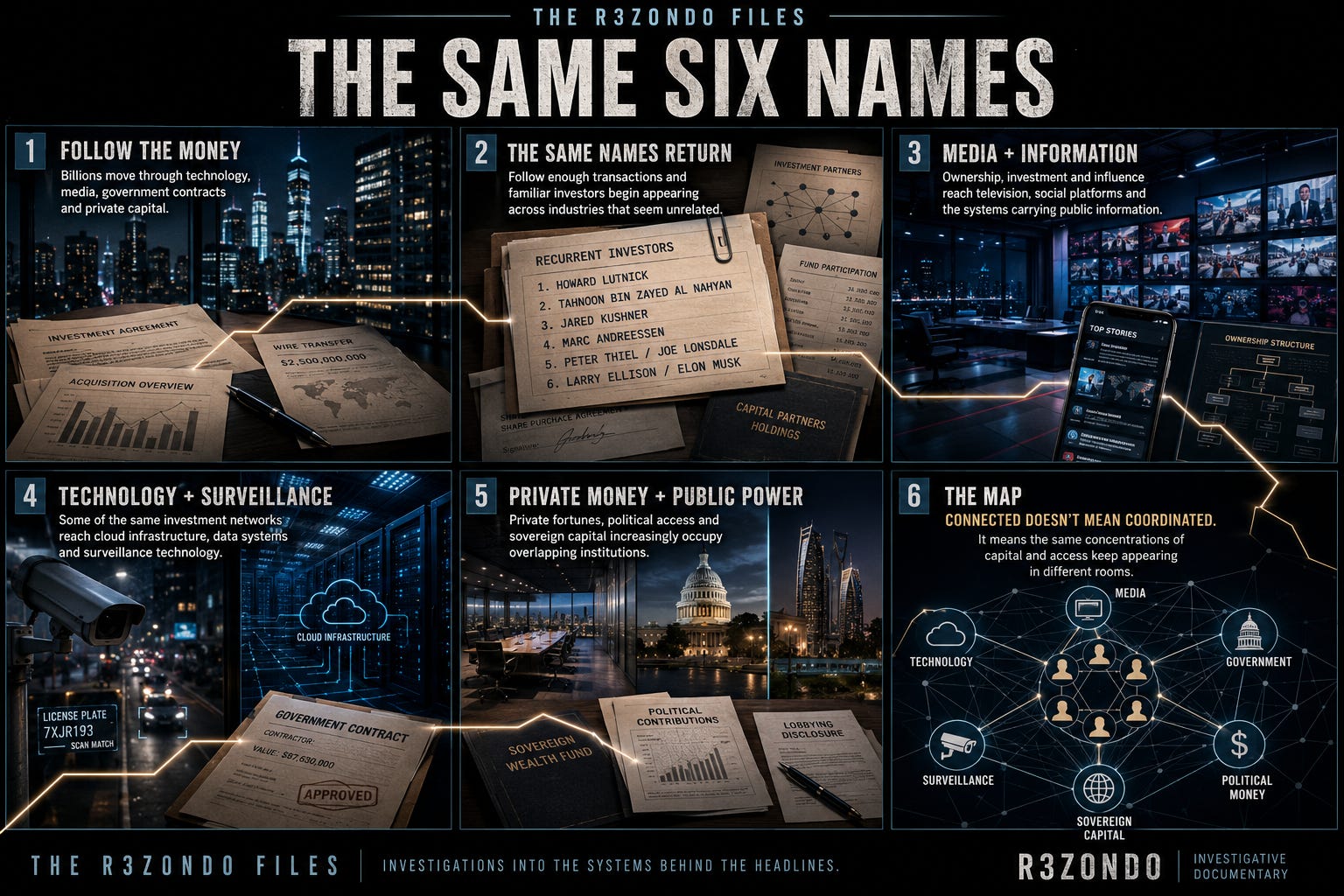
Nobody had to conspire for this to happen, a dozen people with enough money to be everywhere at once will, eventually, be everywhere at once. The pattern doesn’t require a meeting, it just requires enough capital and enough years.
X. What This Isn’t
It would be easy to read all of this as one plot with one author, it isn’t that, and saying so would be dishonest.
Andreessen’s own AI super PAC has reportedly irked the White House, precisely because it backs candidates in both parties rather than only Republicans, a genuine crack in the idea that everyone named here is simply working together toward one goal. The man who ran DOGE isn’t in this administration’s good graces anymore, either. Musk left his government role in May 2025 as his scheduled term as a special government employee ended. He had already publicly criticized Trump’s spending bill, and their relationship fractured openly days later as that fight escalated. Tahnoon’s money benefits the president’s family directly; Kushner’s money runs through a fund that pays him regardless of performance; these are overlapping interests, not a single coordinated interest. Truth Social, the platform closest to Trump personally, has no targeted strategic investor from this network at all, its ties to BlackRock and Vanguard run through passive indexing, not a deliberate bet in the way the strategic investments traced through the rest of this piece are.
The most honest way to describe this network is not a conspiracy, it’s a small number of people with enough capital to show up, again and again, in rooms most Americans will never see the inside of, sometimes aligned, sometimes competing, always present.
XI. The Part About This Platform
One more disclosure, because an investigation that hides its own position isn’t an investigation.
This piece is published on Substack. Andreessen Horowitz has led multiple Substack funding rounds since 2019, the same firm sitting inside sections V, VI, VII, and VIII of everything you just read. A smaller investment came from 1789 Capital, the fund co-founded by Donald Trump Jr., Rebekah Mercer, and Omeed Malik, the same Malik who joined Fannie Mae’s board in April 2025 after FHFA Director Bill Pulte announced his appointment. Pulte’s family office had separately invested in GrabAGun, an online gun retailer Malik took public through his own SPAC, before Pulte entered government, and where Trump Jr. sits on the board.
It isn’t just Trump Jr. Eric Trump is an investor in and chief strategy adviser to Foundation Future Industries, a startup developing military humanoid robots, and later went on Fox Business to promote the company’s new $24 million Pentagon contract. Trump Jr. separately holds a stake, through 1789 Capital, in a rare earth company that landed a $620 million Pentagon loan, and joined a drone company’s board for stock compensation shortly before it won an Army order. Three sitting senators, Warren, Schumer, and Wyden, have opened a formal investigation into whether Trump affiliated companies, including several already named, received unusually broad protections through the separate Trump family lawsuit settlement against the IRS. That pattern is large enough to deserve its own accounting elsewhere; this piece just notes that it exists.
I found no evidence that either investor has ever touched the editorial content on this platform, including this piece, but the honest disclosure is the one that doesn’t wait to be asked for.
XII. What Stays
None of this arrives with a flag or an announcement, it arrives as a funding round, a management fee, a stablecoin, a stock purchase sitting in a disclosure most people will never read. Every piece of it will outlast whatever headline runs this week, because none of it belongs only to this week.
Six names sit at the center of this map, Tahnoon, Andreessen, Jared Kushner, Lonsdale, Lutnick, and Ellison, with Musk and a handful of large institutional investors and sovereign funds, including BlackRock, Qatar’s QIA, and Saudi Arabia’s PIF, repeatedly appearing alongside them. Follow it far enough, and eventually you stop finding new people; you just find the same six names attached to different entities, on different letterhead, standing in different rooms.
Vote! Research the politician, ask who benefits, and who’s funding them. Bring someone who wasn’t planning to look.
Every investigation begins with a question. Finding the answer requires time, research, public records, and source verification. If you value independent investigations like this one, please become a paid subscriber for just $6 a month. Your support keeps this work independent.
Sources
Section I-II (Lutnick/Cantor/Epstein): Primary: DOJ Epstein Files (EFTA01315125, EFTA02438886, EFTA00289560, EFTA02573653); House Committee on Oversight and Government Reform, Howard Lutnick transcribed interview, May 6, 2026; BGC Group’s own SEC filings, including its DEF 14A on the FMX separation and its April 2024 press release naming Lutnick as chairman of both BGC and FMX; ICE’s own SEC/10-Q filings; Southern District of New York’s official DOJ press release and indictment in the Van Dyke case (justice.gov/usao-sdny); New York Attorney General’s official press release (ag.ny.gov); Sens. Warren and Wyden’s Senate Banking Committee letters to both Lutnick and Tether (April 29-30, 2026, official releases at banking.senate.gov), which cite SEC Schedule 13D (Cantor Equity Partners II, Inc., Oct. 6, 2025) and quote the underlying New York credit filing directly, including its “all assets” and “more than half the equity in Cantor Fitzgerald” collateral language; Loeffler’s own financial disclosure. Original reporting: Bloomberg (original investigation breaking the Tether/Dynasty Trust A loan story, March 18, 2026, by David Kocieniewski, Anthony Cormier, and Todd Gillespie), Reuters (lead source on the CFTC investigation and Kalshi’s referral of Perez), CNBC, Forbes, Time, ESPN, Quartz, The Block, CoinDesk, Yahoo Finance. Specialist reporting/analysis: Kait Justice’s independent investigation; The Leah Files’ “Follow the Money on Polymarket” (Aug. 2026, Part 1 of 3), including its citation of the Anti-Corruption Data Collective’s study of Polymarket’s settled markets; BusinessToday and ChinaTechNews.com; Skadden Arps and Sidley Austin client alerts; DefenseScoop.
Section III (Tahnoon): Primary: Paramount’s FCC declaratory ruling petition (FCC ECFS); Oracle’s own blog post (Jan. 13, 2026); Rep. Ro Khanna’s House Select Committee on China investigation; Sens. Warren and Kim’s Treasury letter; USPTO Trademark Security Agreement (Reel/Frame 9022/0667); USPTO Patent Security Agreement (Reel/Frame 72995/858); U.S. Copyright Office Mortgage Security Agreement (Recordation V15038D806); Delaware Division of Corporations entity search; the Paramount-WBD merger agreement (SEC EDGAR, Exhibit 21); WBD’s bridge credit agreement (SEC EDGAR); Senate Finance Committee’s official release of Wyden’s “Looking the Other Way” report; the SEC’s own March 5, 2026 litigation release on the dismissal of claims against Justin Sun. Original reporting: Wall Street Journal, Bloomberg, CNBC, ABC News, Forbes, Fortune, AP, The Hollywood Reporter, Variety, American Banker. Specialist reporting/analysis: The Drey Dossier (Audrey Henson), Intelligence Community News, Nextgov/FCW, The Block, Center for American Progress, BanklessTimes, The American Prospect, ACAMS, CoinDesk, Cryptopolitan, LiquidityFinder.
Section IV (Kushner): Primary: House Judiciary Committee’s official investigation; Senate Finance Committee; EA’s own completion announcement and PIF’s official newswire; IRS’s own March 13, 2026 notice confirming Bessent’s Acting Commissioner service had expired; Sen. Warren’s joint investigation letter with Schumer and Wyden. Original reporting: ProPublica’s original FCC gifts investigation, AP, Washington Post, CNN, ABC News, Bloomberg, Fortune, TechCrunch, NPR, Salon, Accounting Today, Forbes. Specialist reporting/analysis: Jack Poulson’s original investigation into the Barak archive and Kait Justice’s reporting connecting it to Bessent, both explicitly flagged in the body text as reported rather than independently verified; Democracy Defenders Fund’s breakdown of Judge Kathleen Williams’ July 13, 2026 order; Atlantic Council; Times of Israel; CBC Sports; Crunchbase; Techdirt and emptywheel; ASSEMBLY Magazine.
Section V-VI (Andreessen/a16z/Lonsdale): Primary: FEC.gov, Fairshake and Leading the Future PAC filings (Committee ID C00835959); Pennsylvania’s Unified Judicial System docket for Krasner v. Musk (Philadelphia Court of Common Pleas, case 241003509); Wisconsin Elections Commission’s own referral; Sen. Wyden’s official statement summarizing the whistleblower allegations; Microsoft’s own August 8, 2024 newsroom announcement of the Palantir Azure partnership; Oracle’s own blog post announcing the Airis Labs partnership; ICSID’s official case docket for Honduras Próspera Inc. v. Republic of Honduras (ICSID Case No. ARB/23/2). Original reporting: Washington Post, Philadelphia Inquirer, The Times of Israel and Calcalist/Ctech. Additional/corroborating reporting: NPR, PBS NewsHour, Bloomberg, NBC News, CNBC, ABC News/GMA, CBS Philadelphia, The Register, Fox News, Axios, TechCrunch, Variety, Wired, Bloomberg Law, Reuters, Wisconsin Public Radio, Fox11 Green Bay. Specialist analysis/trade press: Revolving Door Project, Jacobin, Cato Unbound, Nextgov/FCW, Constellation Research, DatacenterDynamics, State Affairs, Nieman Lab, Public Citizen’s “Corporate Supremacist Super PACs” report. Specialist/additional reporting: Liberation News, Pulse 2.0, International Relations Review, resilience.org. Company/database references: Dealroom.
Section VII (Flock/Toka/Carbyne/Axon): Primary: Chatrie v. United States (Supreme Court, No. 25-112); Axon’s own Q1 2026 earnings call. Original dataset/originating analysis: haveibeenflocked.com’s own published analysis of 233 million FOIA’d Flock search logs. Original reporting: Forbes (Thomas Brewster), CNBC. Specialist reporting/analysis: The Leah Files, Electronic Frontier Foundation’s own protest-surveillance analysis, The Policing Project, Yahoo Finance.
Section VIII (X/Meta/OpenAI/Newsmax/Truth Social): Primary: Meta Platforms’ own 2026 definitive proxy statement and 8-K filings; SEC filings for Newsmax Inc., Trump Media & Technology Group, and Vanguard’s Schedule 13G/A on CoreCivic; Newsmax Inc. Schedule 13G (April 2025); Newsmax’s own 2026 proxy statement; OpenAI’s own March 31, 2026 funding and credit-facility announcement, and Microsoft’s own 8-K SEC filing; House Judiciary Committee Democrats’ official press release; Newsmax Inc. investor-relations announcement (July 28, 2026). Additional/corroborating reporting: Rolling Stone, NBC News, CNBC, Nasdaq. Original reporting: Washington Post and ICIJ, Bloomberg Law, Wall Street Journal, New York Times, Fortune, CNBC, NPR, France24, Newsweek, The New Republic, The Daily Beast, Mediaite, TheWrap. Specialist reporting/analysis: KeepTrack.space and RevenueMemo, The Desk and MediaCopilot, Yahoo News, Washington Examiner, New York Post.
Sections IX-X (The Map/What This Isn’t): Synthesis of findings documented and sourced in Sections II-VIII above. Additional reporting for Section X: NBC News, CNBC and Gizmodo, CNBC and Fox News, Axios. Sovereign-fund sourcing: xAI’s own funding announcements, reporting on PIF’s Humain division.
Section XI (Substack disclosure/1789 Capital/Fannie Mae/Trump family Pentagon contracts): This section also relies on Substack/a16z financing sourcing established in Section V. Primary: Sen. Warren’s July 7, 2026 joint investigation letters with Schumer and Wyden; Fannie Mae’s April 15, 2025 Form 8-K; GrabAGun/SPAC SEC filings; Unusual Machines’ SEC filings. Original and additional reporting: Bloomberg; Pulte Family Office’s Jan. 15, 2025 investment announcement, with Bisnow and Revolving Door Project as additional reporting; ProPublica’s May 28, 2026 investigation and Financial Times reporting on the Vulcan Elements chronology; Wall Street Journal reporting on Unusual Machines’ October 2025 Army motor order; Fortune and CNBC. Specialist/additional reporting: Revolving Door Project, Bisnow, Inman Real Estate News, Benzinga, ASSEMBLY Magazine.
Section XII (What Stays): Concluding synthesis of findings sourced in Sections I-XI above.
Sources include primary government and corporate records, court filings, congressional materials, and attributed reporting. The source notes distinguish primary material from original and specialist reporting.
I need to sit down and draw a very large diagram.
Wow, given Ashley st Clair’s testimony of madman musk interfering with voting machines; how he tried to control Iran uprising with his starlink; if all of these are connected online to star link, he could technically turn it all off on a whim? 🤯
Never knew about the north woods plot, but evil men willing to kill Americans to start a war, pales in comparison. This isn’t about right vs left, it’s about good vs evil. 😏.